
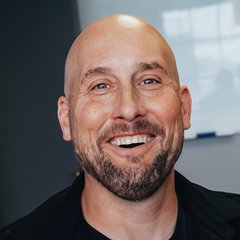
My mom ran a skateboard shop out of the Topeka Flea Market when I was growing up. Not a real storefront. A booth in a flea market. She was the ultimate bootstrapper, selling Tony Hawk decks and grip tape between the guy hawking used power tools and somebody's grandmother selling quilts. I didn't think much of it at the time. It was just where I spent my afternoons. But I've been thinking about it lately, and I realize that flea market booth taught me more about business than anything I've learned since.
The first thing skating teaches you is how to fall. Not metaphorically. Literally. You learn to fall with your body loose, to roll instead of catching yourself with stiff arms, to turn a crash into something your body can absorb. I must have fallen hundreds of times learning to ollie. The interesting thing isn't that I fell. Everyone falls. It's that falling correctly is a skill. There's a right way and a wrong way to hit the ground, and the difference between the two is whether you can get back on the board in five seconds or you're sitting on the curb for twenty minutes.
I think this is more precise than the usual "embrace failure" advice you hear in business. The cliché says failure is good. But that's too vague to be useful. What's actually good is learning to fail in a way that doesn't take you out of the game. Having a plan for when things go wrong. Knowing which falls you can absorb and which ones mean you probably shouldn't have been trying that trick on that particular rail. Good skaters aren't fearless. They're good at calculating which risks are worth the bruises.
There's something else, though, that I only started to appreciate recently. When you're a skater, you look at the world differently. You walk past a building and you don't see a handrail. You see a line. An empty pool isn't a maintenance problem. It's a bowl. You develop this habit of seeing possibility in infrastructure that was built for some completely different purpose.
I've been doing that in business for twenty years and didn't connect it back to skating until I started writing this. The ability to look at something everyone else sees as fixed and ordinary, and notice that it could be used in a way nobody intended. That's maybe the most valuable skill I have. I'm not sure you can teach it directly. But I know where I learned it.
The other thing is the crew. My friends David and Terry and I used to skate together constantly. We'd teach each other tricks, spot each other, talk through what went wrong when somebody ate it on a kickflip. There's a version of this that sounds like the generic "build a strong team" advice, but that misses what was actually happening. We weren't a team in any organizational sense. We were people who made each other better by being around. When David landed something new, it raised my ceiling. Not because of competition, but because seeing someone you respect do something hard makes you believe you can do it too. The best business relationships I have work exactly the same way.
My mom's booth at the Topeka Flea Market wasn't exactly a venture-backed operation. She had no storefront, no ad budget, no business plan that I ever saw. What she had was that she genuinely cared about the kids who showed up. She knew their names. She knew which ones were going through hard times at home. She priced things so the kids in the neighborhood could actually afford them. She built something real out of almost nothing, in a flea market, because she cared more about the people than the margins. I've worked with hundreds of business owners since then, and the ones who build something that lasts almost always have some version of this quality. They care about the people they serve in a way that isn't strategic. It's just who they are. The strategy part comes later, when you realize that this kind of caring is actually a massive edge. But it only works if it's real.
I still skate every week. I picked it up again a few summers ago after a couple decades off, and the muscle memory came back faster than I expected. I even got my ollie back. But the important stuff, how to fall, how to see lines, how to keep trying a thing that seems impossible, turns out those don't leave you.
I still have that Tony Hawk board. It sits where I can see it. Not because it's worth anything, but because it reminds me that the journey is the thing. Not the destination, not the exit, not the number. The journey. I think most of what I know about building businesses, I learned at the Topeka Flea Market before I was old enough to drive.